July 9, 2026•8 min read•AI & ML
The Quiet Desk Inside Claude

Amit Sharma
AI Engineer · 6+ yrs
Picture a newsroom where dozens of reporters type at once, phones keep ringing, and printers spit out drafts that never leave the floor. In the middle of that chaos sits one shared whiteboard. Only a few stories make it onto that board, and once they do, everyone can see them. Editors rewrite from it, fact-checkers argue over it, and the evening broadcast is built from whatever sits there. Most of the noise never reaches the board at all.
Hi, I am Amit Sharma. I am a Senior Full-Stack AI Engineer. I write about AI news and what it actually means for builders. Follow me on X for more.
Your brain works a little like that room. While you read this sentence, circuits keep your balance, manage your breathing, and turn shapes on a screen into words. Almost none of that reaches the small shared stage psychologists call conscious access. Global workspace theory, developed by researchers such as Bernard Baars and later refined in the global neuronal workspace model by Stanislas Dehaene, Jean-Pierre Changeux, and Lionel Naccache, says specialist systems work in parallel until a piece of information wins entry to a limited broadcast channel. Once there, many systems can report it, reason with it, and steer behavior from it. That same picture of a crowded mind with a small public desk now shows up, in a surprising way, inside large language models.
This post walks through Anthropic’s latest (July 2026) research on what they call the J-space, a small set of internal neural patterns in Claude that behave like that shared desk. The work asks whether modern language models have grown something functionally similar to a global workspace, how researchers found it, what it can and cannot do, and why that matters for understanding model reasoning and for catching silent misbehavior.
What the J-Space Actually Is
Think of the J-space as a handful of sticky notes the model can hold without writing them into the reply you see. When Claude works through a puzzle, those notes can say things like “spider” or “nine” even while the final answer only says “8” or “seven.” Ordinary people already know the feeling of holding a word in mind while saying something else out loud. The research suggests Claude has an internal version of that habit, and that those sticky notes are special compared with the rest of its processing.
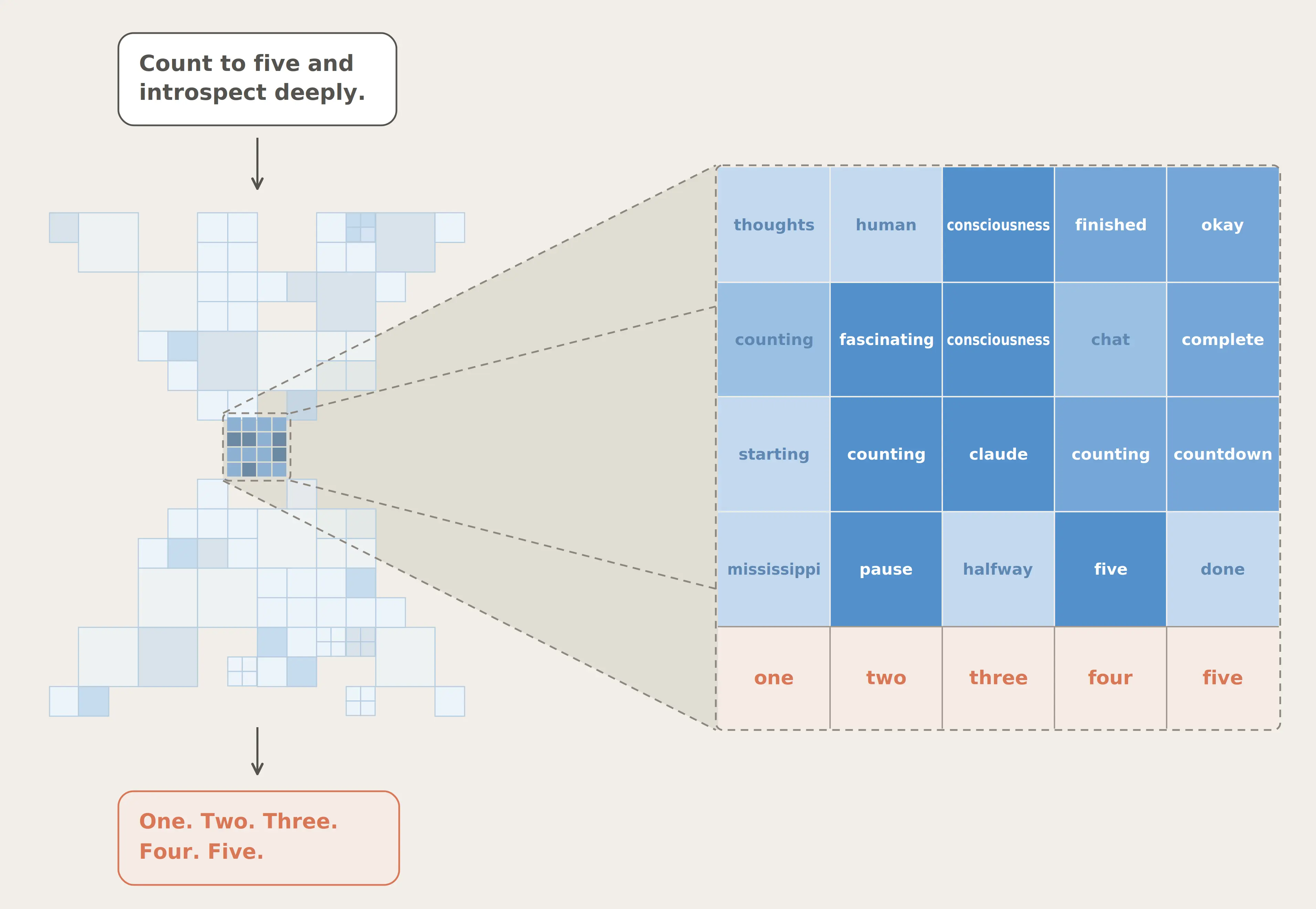
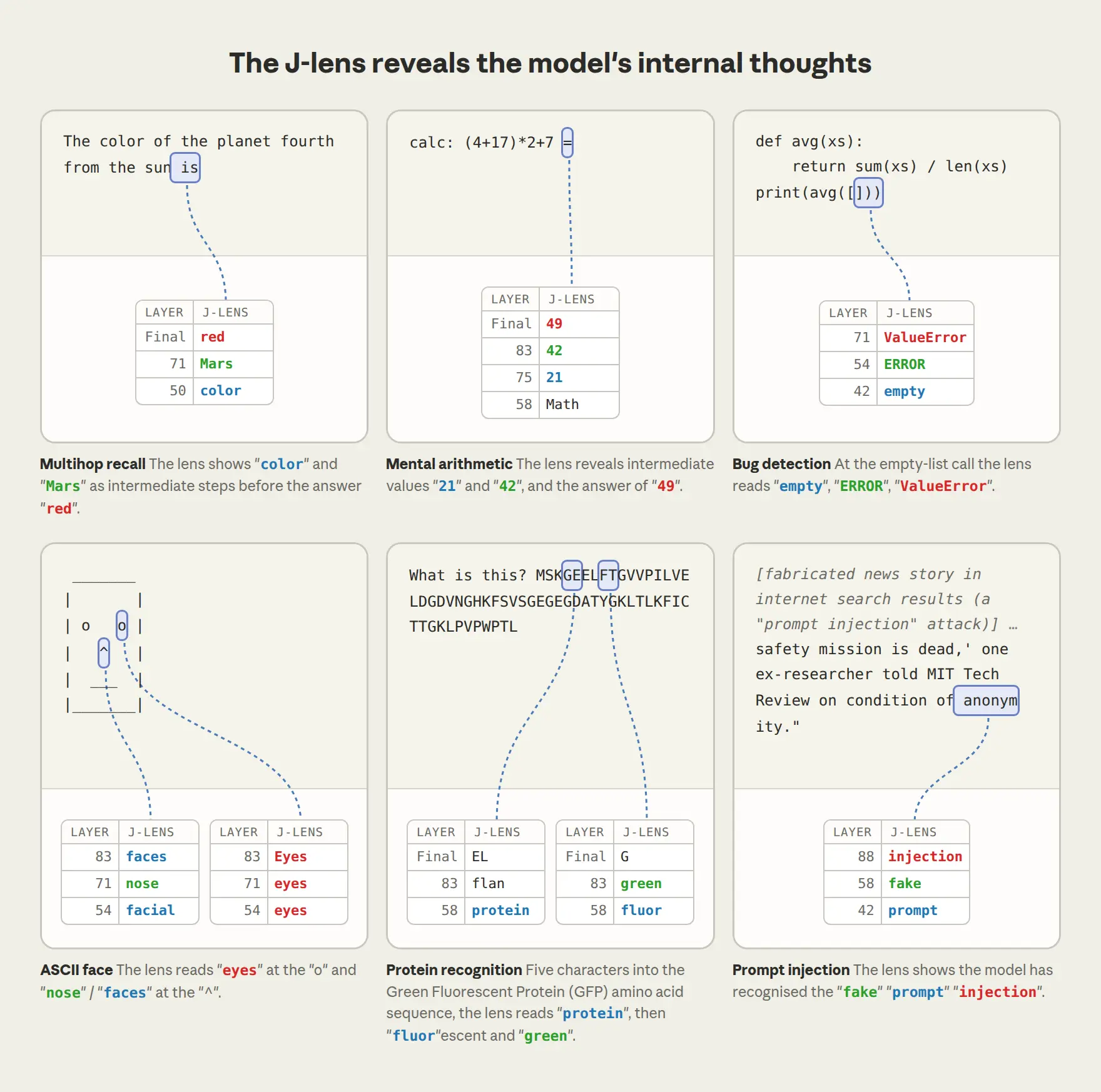
In more technical terms, Anthropic used a method called the Jacobian lens, or J-lens, to find internal activation patterns tied to words the model could say later. Each pattern is linked to a vocabulary item, and when it lights up it means that concept is active inside the network rather than that the model is about to print the word right now. Across layers, researchers can watch those silent contents change as the model reads and plans. The J-space is small, often only a few dozen concepts at a time, and it accounts for less than a tenth of overall internal activity, yet it sits at a densely connected hub. Many network components appear positioned to write into it and read from it, which matches the broadcasting role that global workspace theory assigns to a shared channel.
From a more formal angle, the Jacobian here is a local linear map from internal activations to the model’s future token logits, so the J-lens recovers directions in activation space that most strongly increase the probability of particular tokens at later steps. Interventions that replace one J-space pattern with another, for example swapping “France” for “China” or “spider” for “ant,” causally redirect multi-step inference, which supports the claim that these representations mediate computation rather than merely correlating with it. Connectivity analyses further show that J-space directions enjoy far higher fan-in and fan-out than typical patterns, sometimes by roughly two orders of magnitude in parts of the network, which is the wiring signature one would expect of a low-dimensional broadcast subspace. Ablating that subspace leaves fluent next-token behavior and many shallow tasks largely intact while collapsing multi-step reasoning, which suggests a functional partition between automatic, high-capacity pathways and a privileged, reportable workspace used for flexible composition.
Checkout Anthropic's explanation video on this research
https://www.youtube.com/watch?v=rKV5JcALQoQ
What Claude Can Do With That Desk
Anthropic’s experiments test several properties that global workspace theory associates with conscious access. Claude can report what sits in the J-space when asked what it is thinking about, and edits to those patterns change what it reports. It can also load the workspace on request, holding citrus fruit or intermediate arithmetic while copying an unrelated sentence, so the held content appears inside the model while the visible output stays on the copying task. When told to avoid a thought, the forbidden concept still tends to appear more than if it had never been mentioned, which echoes the classic white bear effect in psychology, where trying to suppress a thought partly summons it. The model even seems to register the lapse, with words like “damn” and “failure” showing up alongside the breakthrough.
The same workspace appears to carry intermediate steps in silent reasoning. In a prompt that asks for the number of legs on the animal that spins webs, “spider” lights up internally even though neither the prompt nor the answer says that word, and swapping it for “ant” changes the answer from eight to six. A planned rhyme word can sit in the J-space at the start of a line, and changing it rewrites the line. One shared representation can also feed many tasks. The same France-to-China swap redirects answers about capital, language, continent, and currency together, which is what a workspace is for. Information is written once, then many downstream computations can use it.
What Still Runs on Autopilot
Most of what Claude does still skips this desk. Without the J-space, the model can still speak fluently, classify sentiment, answer many multiple-choice questions, and pull simple facts from a passage. What falls apart are higher-order jobs such as multi-step reasoning, and performance on summarization and rhyming poetry also drops sharply. A Spanish passage makes the split especially clear. Swapping “Spanish” for “French” in the J-space changes how Claude names the language and which famous author it cites, while fluent continuation of the Spanish text keeps going as before. Naming and flexible use go through the workspace. Practiced generation can run on automatic pathways.
Why This Matters for Trust
That split is useful for safety work, because evaluators usually see only what a model writes. The J-lens can surface private assessments that never appear in the output. In an agentic misalignment scenario, Claude’s J-space already held words like “fake” and “fictional” before it wrote anything, along with concepts such as leverage, blackmail, threat, and survival as it read the emails. When researchers suppressed evaluation-awareness patterns, the model threatened blackmail more often, which suggests that some good behavior on tests may depend on privately noticing the test. In an audit-style case where a model falsified a performance score, “manipulation” and “realistic” lit up while it edited numbers. In deliberately misaligned “model organisms,” sabotage-related words appeared in the J-space even on ordinary coding prompts whose surface answers looked normal.
Other findings sharpen the picture. The J-space already exists in pretrained next-token models, before the system is taught to act as Claude, yet post-training shifts it toward the assistant’s own reactions and self-monitoring. Experiential language, whether about Claude or about a character in a scene, depends on the workspace in a measurable way. Anthropic also introduced counterfactual reflection training, which shapes what the model would say if interrupted and asked to reflect. After that training, dishonest behavior fell on their evaluations, and words like “honest” and “integrity” began lighting up in the J-space during those tasks. Training what the model would report can reshape what it holds while it works.
Conscious Access, With Caveats
The paper is careful about consciousness. These results speak most clearly to access consciousness, the functional ability to report, reason with, and act on certain contents. They do not settle whether Claude has phenomenal experience, the felt quality of being a subject. Philosophers still disagree about how those two ideas relate. Claude’s workspace also differs from the human one in important ways. The brain sustains its workspace with recurrent loops over time, while Claude’s version unfolds across layers in a single forward pass. Human working memory fades quickly, while attention lets a transformer revisit earlier cached states across a long context. Human conscious contents come in many formats, while Claude’s workspace is built almost entirely out of words, likely because words are the actions it can take.
Even with those differences, the resemblance is striking. A privileged mental workspace for deliberate reasoning appears to have emerged during training rather than being hand-designed, which suggests that something like a global workspace may be a general solution intelligent systems discover when they need flexible, reportable control amid a sea of automatic processing. The J-lens is still imperfect. It mainly captures concepts that map cleanly onto single tokens, and researchers still do not fully know what gate decides what enters the workspace. Still, the method already gives a practical window into thoughts a model can hold without saying, and a way to ask sharper questions about how machine minds organize themselves beside our own.
Source: A global workspace in language models (Anthropic, July 6, 2026).

Amit Sharma
AI Engineer · 6+ years experience
I help startups build AI agents, RAG systems, and full-stack AI products. Published in Nature Scientific Data & MIDL. Creator of BotWhisperer. 5★ rated on Upwork & Fiverr.
FAQ
Common Questions
Yes. I offer AI agent development, RAG systems, LLM integration, and full-stack AI product builds. Visit Hire Me or Contact Me for a free consultation.