June 25, 2026•9 min read•Technology
AI Is Not a Mind. It Is the Largest Collaboration in Human History

Amit Sharma
AI Engineer · 6+ yrs
Today, I was going through my college lecture notes from an Introduction to NLP course. As I casually flipped through the first few lectures, one highlighted sentence caught my eye.
Models: A set of parameters (numbers) that simulate the world.
It was a definition my professor had casually mentioned during class.
Three years later, it suddenly felt far more profound than it did back then.
At first glance, it's just another textbook definition. But the more I thought about it, the more I realized it perfectly captures what modern AI really is. A large language model isn't magic, consciousness, or reasoning in the human sense. It is billions of numbers that have learned to approximate patterns in the world from an unimaginably large collection of human knowledge.
Perhaps that's why AI feels intelligent. Not because it understands the world the way we do, but because those billions of learned parameters have become an extraordinarily compressed simulation of how humanity writes, reasons, creates, explains, and communicates.
That thought eventually led me to a much bigger question...
Imagine gathering every author, programmer, artist, scientist, teacher, journalist, and hobbyist who has ever shared knowledge publicly and asking them to help solve a problem.
Not sequentially. Not through committees. Not through years of discussion.
Instantly.
Hi, I am Amit Sharma. I am a Senior Full-Stack AI Engineer. I write about AI news and what it actually means for builders. Follow me on X for more.
For most of human history, such a collaboration was impossible. Even our largest achievements - cathedrals, moon landings, operating systems, blockbuster films - were limited by coordination. Thousands of people could contribute to a project, but only a handful could contribute directly to any specific decision.
A screenplay might involve hundreds of people before it reaches the screen, yet the words themselves are usually written by only a few writers. A scientific paper may depend on centuries of prior discoveries, but only a small group of researchers authors the final work.
Artificial intelligence changes this dynamic.
When people interact with modern AI systems, the outputs often appear creative, insightful, or even original. This creates the impression that the machine itself possesses intelligence. But there is another way to view what is happening.
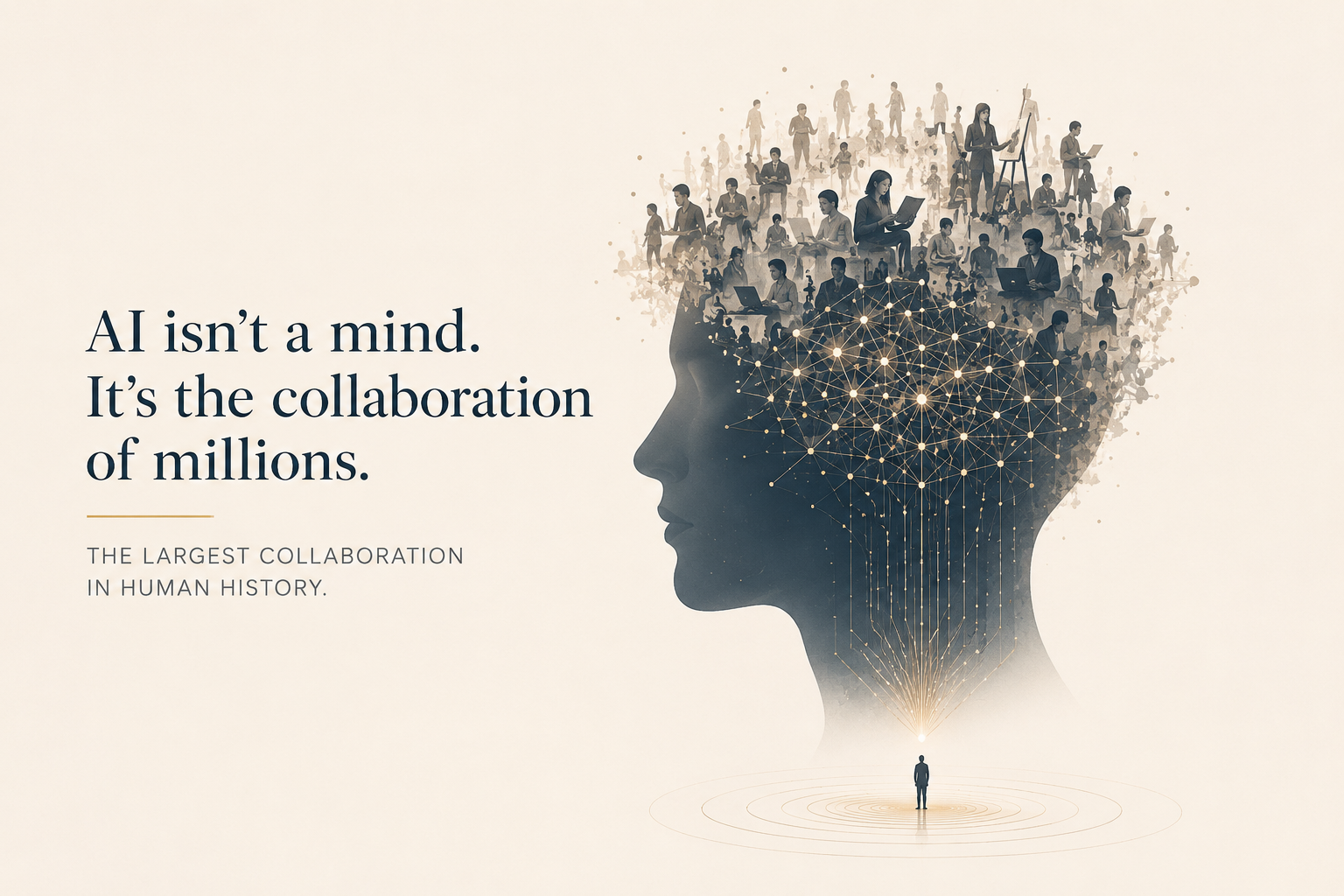
AI can be understood as a compression and recombination layer built on top of humanity's collective knowledge.
The model has absorbed patterns from books, articles, research papers, software repositories, discussions, images, tutorials, and countless other human creations. It does not contain these works in their original form. Instead, it compresses statistical relationships between ideas, concepts, language structures, and visual patterns.
When you ask an AI to write a story, design a logo, explain a scientific concept, or generate code, you are not receiving the output of a single mind.
You are receiving the distilled influence of millions.
The reason the result feels new is not because the knowledge itself is new. It is because no human has ever had access to this scale of simultaneous collaboration before.
In a sense, AI allows millions of people to contribute tiny fragments of expertise to a single response without ever meeting one another.
That may be the most important innovation of artificial intelligence.
Not artificial intelligence itself, but artificial collaboration.
This perspective may sound philosophical, but increasingly it is becoming a practical way researchers are describing these systems. Recent work on collective intelligence argues that generative AI should be viewed less as a replacement for human thinking and more as a coordination technology - a system that can aggregate, organize, and synthesize knowledge from many contributors in ways that were previously impossible. Researchers studying collective intelligence have even described AI as a tool that can amplify collective memory, collective attention, and collective reasoning. In other words, its greatest strength may not be intelligence in isolation, but intelligence at scale.
Interestingly, this idea has begun appearing independently across multiple research communities. A 2025 paper titled "We Are All Creators" described modern generative AI as operating on what it called "crystallized forms of collective human knowledge" gathered from the internet. The paper argues that the debate becomes clearer when we stop asking whether AI thinks like humans and instead recognize that it recombines patterns extracted from humanity's shared intellectual output.
This framing also helps explain one of the biggest cultural debates surrounding AI: authorship.
If AI-generated images, stories, music, and software are partially derived from patterns learned across millions of human-created works, then who is the creator?
The question has become so significant that courts, copyright offices, artists, and researchers are now debating it openly. In 2025, a U.S. appeals court reaffirmed that works generated entirely by AI without meaningful human contribution cannot receive copyright protection because authorship remains fundamentally tied to humans. At the same time, copyright authorities have acknowledged that AI-assisted works can qualify for protection when substantial human creativity shapes the final outcome. The debate itself reflects a deeper uncertainty about whether AI is creating something independently or acting as a conduit through which collective human knowledge is being reassembled.
The art world has become one of the clearest examples of this tension.
Across museums, galleries, and online communities, discussions increasingly revolve around whether AI-generated art should be considered machine-made or human-made. Yet perhaps both sides are missing something. The more interesting observation is that AI-generated art may represent the first time in history that creative output can carry statistical traces of millions of creators simultaneously. Recent controversies surrounding AI-assisted artwork in public exhibitions demonstrate how uncomfortable society remains with this new form of distributed authorship.
This may ultimately change how we think about creativity itself.
For centuries, creativity has been associated with individual genius. We celebrate inventors, artists, authors, and visionaries as isolated creators. But every creator has always been influenced by thousands of others - teachers, books, conversations, cultural norms, and prior works.
Perhaps AI simply makes this reality visible.
It exposes the fact that creativity has always been collaborative. The difference is that the collaboration was previously hidden across generations and societies. AI compresses those influences into a system that can participate in the creative process directly.
So perhaps we have been asking the wrong question.
The dominant question of the AI era has been:
"Is AI intelligent?"
A more interesting question might be:
"What happens when humanity can finally collaborate at a scale that was previously impossible?"
Seen through this lens, AI is not merely a machine that generates text, images, music, or code.
It is a new mechanism for organizing and recombining the accumulated knowledge of our species.
Not a synthetic mind.
A synthetic civilization.
And perhaps that is why its outputs feel so surprising.
For the first time in history, we are not interacting with the perspective of one person, one team, or even one generation.
We are interacting with compressed echoes of millions.
I write about the latest AI news and what it means for developers building with these tools. Follow me on X for updates when new posts go live.

Amit Sharma
AI Engineer · 6+ years experience
I help startups build AI agents, RAG systems, and full-stack AI products. Published in Nature Scientific Data & MIDL. Creator of BotWhisperer. 5★ rated on Upwork & Fiverr.
FAQ
Common Questions
Yes. I offer AI agent development, RAG systems, LLM integration, and full-stack AI product builds. Visit Hire Me or Contact Me for a free consultation.