June 16, 2026•8 min read•Technology
SpaceX Just Bought Cursor for $60 Billion - and Nothing About Your Dev Stack Will Feel the Same

Amit Sharma
AI Engineer · 6+ yrs
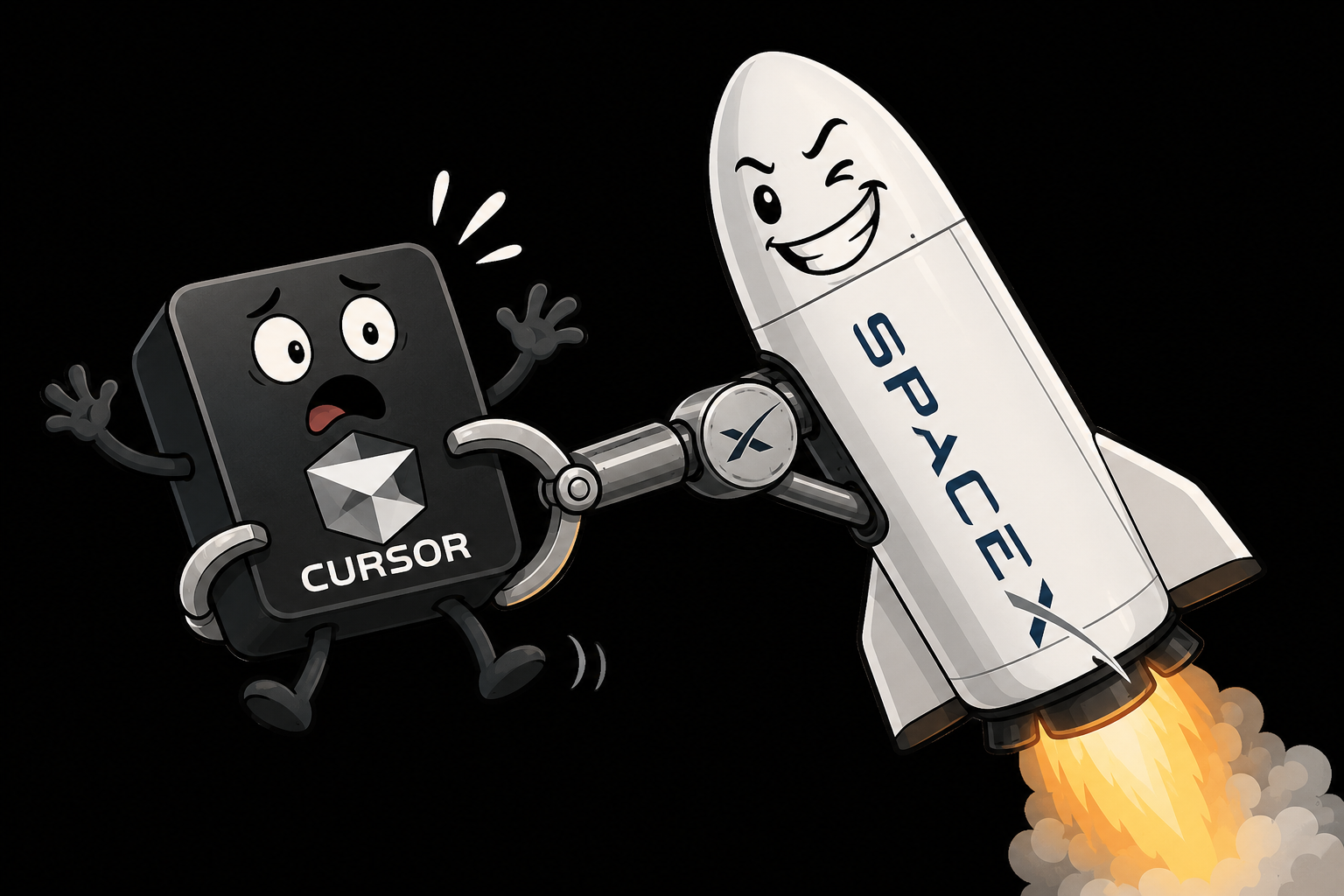
On June 16, 2026, SpaceX filed an SEC 8-K that made the internet lose its mind:
SpaceX is acquiring Cursor - the company behind the AI code editor - for $60 billion. All stock.
Not a partnership. Not a licensing deal. A merger. Anysphere (Cursor's parent company) survives as a wholly owned SpaceX subsidiary. Expected close: Q3 2026, pending regulatory approval.
This lands four days after SpaceX's record-breaking Nasdaq debut - the largest IPO in history - and roughly two months after Musk's company first floated the idea in April with one of the strangest deal structures Silicon Valley has seen in a while: buy Cursor for $60B, or pay up to $10 billion to walk away and "work together" anyway.
If you write code for a living, this is not abstract finance news. This is about the tool many of you have open right now.
Hi, I am Amit Sharma. I am a Senior Full-Stack AI Engineer. I write about AI news and what it actually means for builders. Follow me on X for more.
What Actually Happened
The paperwork is straightforward even if the number is absurd.
- Buyer: Space Exploration Technologies Corp. (SpaceX)
- Target: Anysphere, Inc. (Cursor)
- Structure: Merger via subsidiary X67 Inc.; Cursor survives as a SpaceX subsidiary
- Price: $60 billion implied equity value, paid in SpaceX Class A shares
- Exchange ratio: Based on SpaceX's 7-day VWAP before closing
- Timeline: Q3 2026, subject to regulatory approvals
SpaceX announced the move on X:
https://x.com/SpaceX/status/2066873915717136548
Cursor CEO Michael Truell (25, MIT alum, co-founded Anysphere in 2022) posted:
https://x.com/mntruell/status/2066874098001883538
That's the corporate version. The subtext is louder.
Why SpaceX Wanted Cursor
Strip away the rocket company branding and the logic is clear: SpaceX bought distribution.
Cursor is one of the fastest-growing developer tools on the planet. CNBC reported it crossed $1 billion in annualized revenue by November 2025. Reuters-cited figures put annualized revenue closer to $2.6 billion by the time of the deal. The company was ranked on CNBC's Disruptor 50 list in 2026.
SpaceX itself described the appeal bluntly: Cursor has wide "distribution to expert software engineers." Translation - millions of developers already paste their code, context, and intent into this editor every day.
Meanwhile, SpaceX absorbed xAI (Grok) earlier in 2026 and has been playing catch-up against Anthropic's Claude Code and OpenAI's Codex. Grok has lagged on coding tasks. Cursor is the opposite - beloved, fast-growing, and already deeply embedded in professional workflows.
The April partnership also pointed at compute. Cursor was set to use xAI's Colossus supercomputer in Memphis. SpaceX had already struck similar infrastructure deals with Anthropic and Google ahead of the IPO. Cursor needed GPUs. SpaceX needed a flagship AI application. The merger just removes the middleman.
The Deal That Was Already Telegraphed
This wasn't a surprise ambush - it was an option exercise.
In April 2026, before the IPO, SpaceX disclosed it had the right to acquire Cursor at a predetermined $60B valuation. If the deal fell through, SpaceX would owe a termination fee - CNBC reported $1.5 billion in cash plus $8.5 billion in computing resources.
Cursor, for its part, was reportedly on track to raise $2 billion from Andreessen Horowitz, Thrive, and Nvidia at a $50 billion valuation. It didn't need to sell. SpaceX just made independence expensive.
TechCrunch noted that Microsoft had examined buying Cursor. OpenAI reportedly made two approaches that Cursor leadership turned down. SpaceX won with stock, compute, and timing - right after going public.
The IPO Context Makes It Weirder
SpaceX went public on June 12, 2026 at $135/share. By the morning of the Cursor announcement, shares were trading above $200 in pre-market - adding nearly $1 trillion in market cap in a few days.
TechCrunch did the math: that's roughly 16 Cursors of added value since Friday.
So Musk isn't just buying a coding startup. He's buying it with currency that is, at this exact moment, printing value faster than Cursor generates revenue. The deal feels expensive at $60B. It feels cheaper when your stock is up 50% in four days and you're pitching investors on a $26 trillion AI TAM.
Yes, trillion. SpaceX's IPO materials reportedly attributed $26 trillion of its addressable market to AI - out of ~$28 trillion total. Rockets are almost the side hustle now.
Hot Takes
Fair warning: everything below is opinion. The filing is fact. These are reactions.
1. This was never about rockets. It was about owning the last mile to developers.
SpaceX didn't buy a code editor because astronauts need autocomplete. It bought the interface where professional developers spend their days - the layer where models, data, and workflows converge. Whoever owns that layer influences which models get used, which APIs get called, and which training data flows upstream.
That's not a devtools acquisition. That's platform capture.
2. $60 billion sounds insane until you remember what SpaceX told IPO investors.
If you genuinely believe you're going after a $26 trillion AI market, $60B for the fastest-growing developer surface in the world is a rounding error with excellent PR. The bet is not "Cursor is worth 60 billion dollars as a SaaS company." The bet is "Cursor is the wedge into the enterprise AI application layer we promised Wall Street."
3. Developers who picked Cursor to escape Big Tech may have traded one gravity well for another.
Cursor won hearts by being a focused, fast, AI-native editor - not a Google IDE, not a Microsoft Copilot bolt-on. Now it's owned by a public company whose CEO also runs xAI, X, Tesla, and whatever else is on the whiteboard this week.
The product might not change on day one. The trust calculus already has.
4. The April deal structure is the most Elon thing imaginable.
"Pay $60 billion or pay $10 billion to stay friends" is not a term sheet. It's a marriage prenup written by someone who owns the church, the venue, and the honeymoon resort.
Cursor was growing fast but TechCrunch reported that its planned $2B raise still wouldn't get it to break-even. Compute is expensive. Independence is expensive. SpaceX offered an exit wrapped in inevitability.
5. Grok coding just got a cheat code - and that's the whole point.
xAI has been rebuilding after a rough stretch - co-founder departures, moderation disasters, and a chatbot era best summarized as "we should not have shipped that." SpaceX's own IPO filings flagged AI behavior as a business risk.
Buying Cursor is a credibility transplant. You don't fix Grok's coding reputation with a blog post. You buy the tool developers already respect and wire your models into it.
The Windsurf precedent looms: when acquisition talks get messy, third-party model access can get restricted. If Cursor ever nudges users toward Grok over Claude or GPT, developers will notice immediately.
6. Your code context just became someone else's strategic asset.
Every AI editor is a data pipeline wearing a UX. Cursor sees your files, your diffs, your refactors, your prompts. SpaceX told investors that Cursor's training data was valuable - Gwynne Shotwell reportedly highlighted the quality of Cursor's dataset in interviews ahead of the IPO.
The product promise has always been: your code helps you. The acquisition question is: your code helps whose model?
Privacy policies won't change overnight. Procurement teams will start asking.
7. Antitrust regulators are about to have feelings.
Vertical integration from compute → model → editor → distribution in a single corporate family is exactly the kind of stack competition lawyers lose sleep over. Specialist analyses were already flagging antitrust implications when the April partnership was announced.
A $60B all-stock deal four days post-IPO is not flying under the radar. Expect scrutiny - and expect the "will this close in Q3?" timeline to be optimistic if regulators dig in.
8. Michael Truell didn't lose - he just picked the biggest rocket on the launchpad.
Truell is 25. He built one of the defining developer products of the AI era in four years. Reports suggest he wanted to stay independent - ambition, compute needs, and a $60B check have a way of resolving that tension.
He didn't sell to a sleepy acquirer. He sold into the most valuable hype cycle of 2026, days after the biggest IPO ever, with stock still ripping. If you're going to join an empire, the timing doesn't get louder than this.
9. Claude Code and Codex just got a new kind of rival - not a better model, a better distribution deal.
Anthropic and OpenAI don't just compete on benchmarks anymore. They compete on where coding happens. Cursor historically relied on partnerships with larger labs - it was Anthropic's Claude that helped coin "vibe coding" in the first place.
Now the editor and one of the model providers share a cap table with SpaceX. The coding agent wars just left the playground and entered corporate strategy.
10. Nothing changes tomorrow. Everything changes slowly. That's the scary part.
The editor will still launch. Your extensions will still work. Composer will still autocomplete. The shift won't be a shutdown banner - it'll be a default model toggle, a new training disclosure, a Grok integration announcement, a pricing tier tied to SpaceX compute.
The best acquisitions don't break the product on day one. They bend the roadmap until the product serves the parent company's story.
Watch the roadmap, not the press release.
What to Watch Next
Regulatory approval - Q3 2026 is the stated target. A deal this size, this vertical, this soon after IPO, will get attention.
Model neutrality - Will Cursor keep equal support for Claude, GPT, and Grok? Developers will vote with their feet if the editor becomes a Grok funnel.
Enterprise procurement - Teams with strict data governance will re-evaluate Cursor under SpaceX ownership. Competitors will smell blood.
SpaceX stock volatility - Cursor shareholders are getting paid in SPCX. If the post-IPO rally cools before close, the deal math shifts.
Truell's next move - Does Cursor stay a distinct brand, or slowly become "SpaceX for developers"? The first 90 days post-close will tell you everything.
Bottom Line
SpaceX didn't buy a code editor. It bought the developer.
At $60 billion, four days after the largest IPO in history, with stock still climbing and xAI still rebuilding - this is the clearest signal yet that the AI race is no longer about who trains the best model in a lab. It's about who owns the workflow where that model gets used.
Cursor users didn't ask for this plot twist. But every tab open in an AI editor is now part of someone else's trillion-dollar story.
The code still compiles. The question is who it's compiling for.
I write about the latest AI news and what it means for developers building with these tools. Follow me on X for updates when new posts go live.

Amit Sharma
AI Engineer · 6+ years experience
I help startups build AI agents, RAG systems, and full-stack AI products. Published in Nature Scientific Data & MIDL. Creator of BotWhisperer. 5★ rated on Upwork & Fiverr.
FAQ
Common Questions
Yes. I offer AI agent development, RAG systems, LLM integration, and full-stack AI product builds. Visit Hire Me or Contact Me for a free consultation.